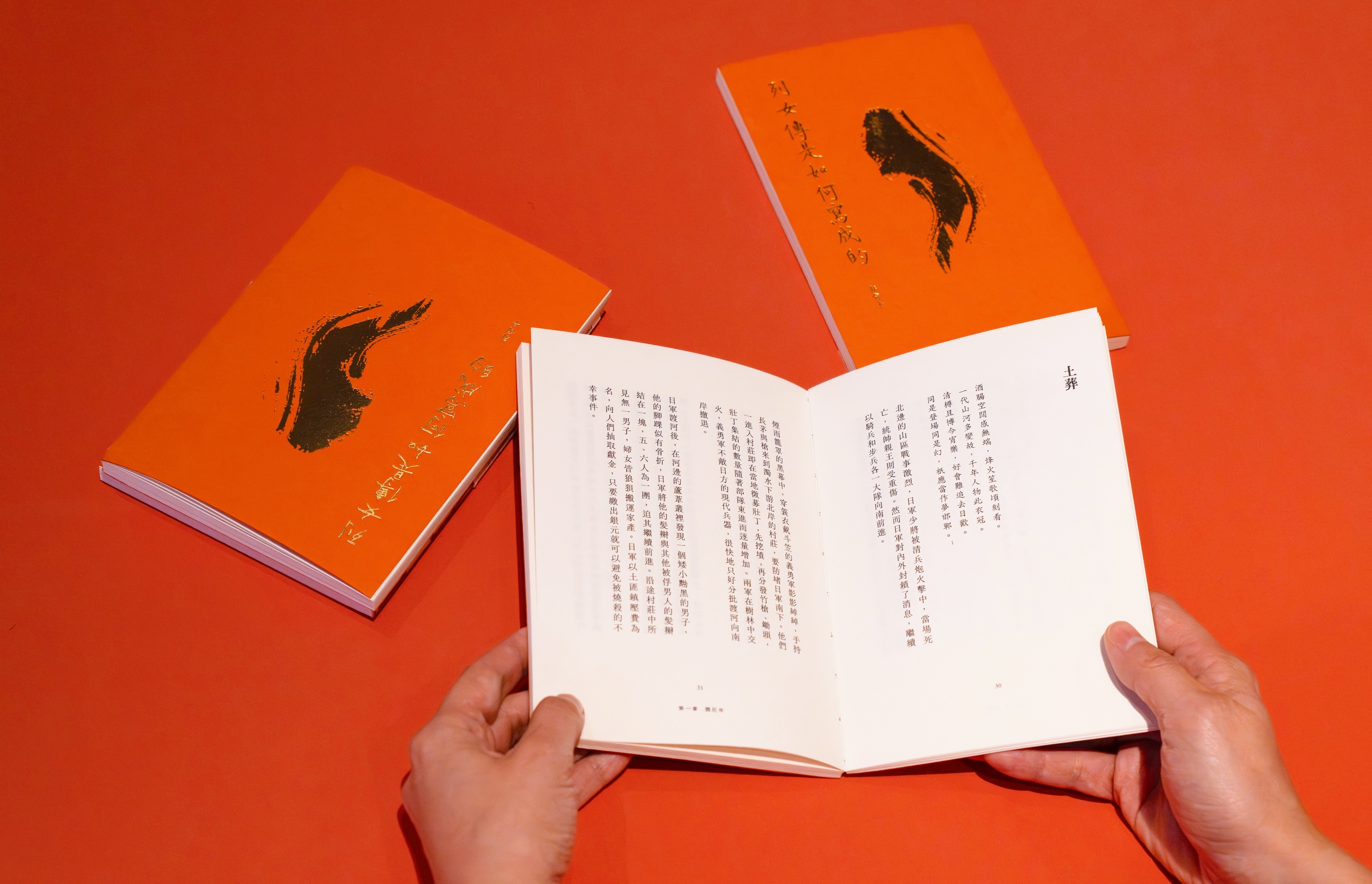
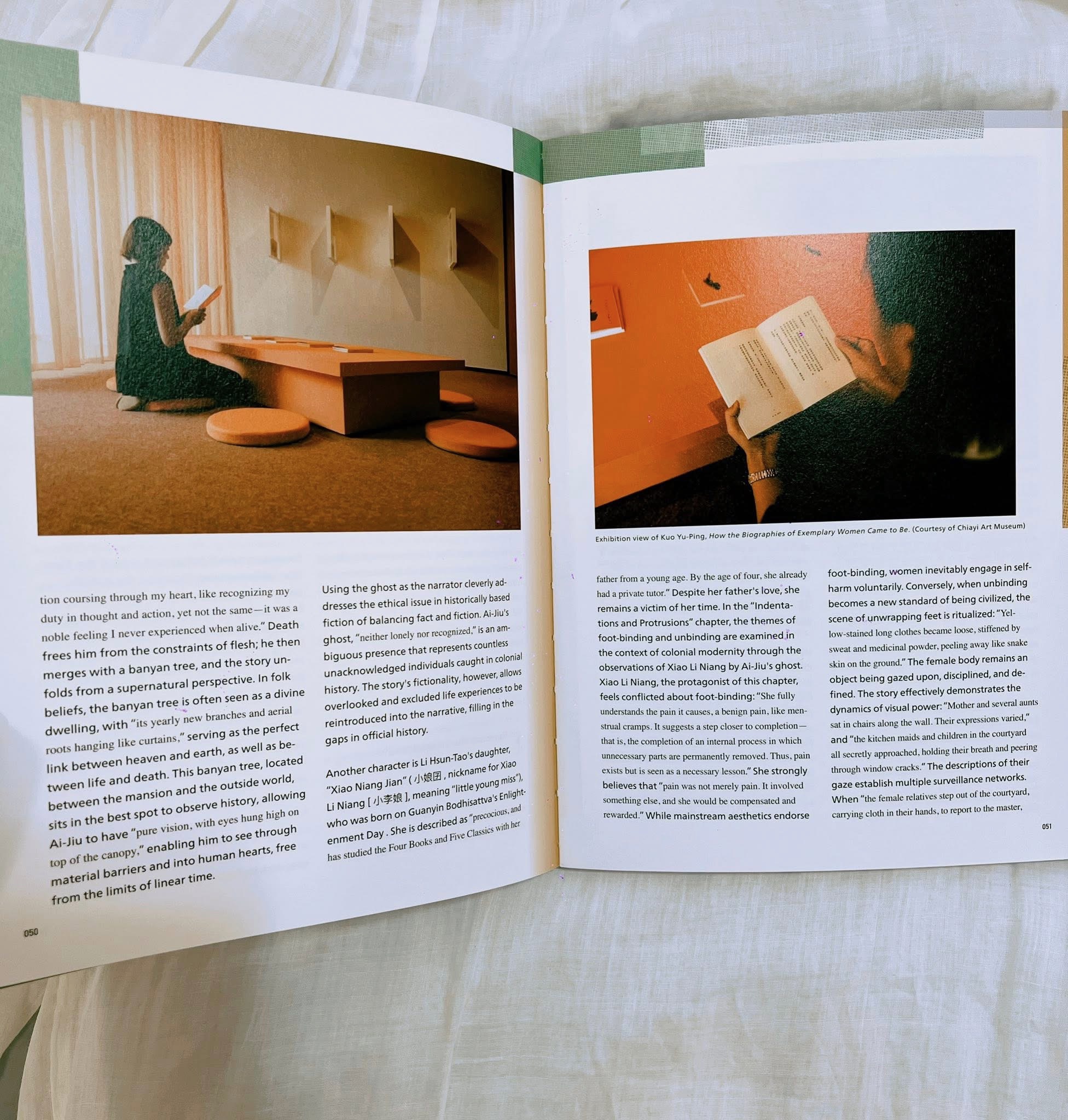
郭俞平在嘉義市立美術館的「相逢在庭前」展覽裡,根據史料杜撰了一本以張李德和(1893~1972)出生的西螺堡為背景的小書:《烈女傳是如何寫成的》。
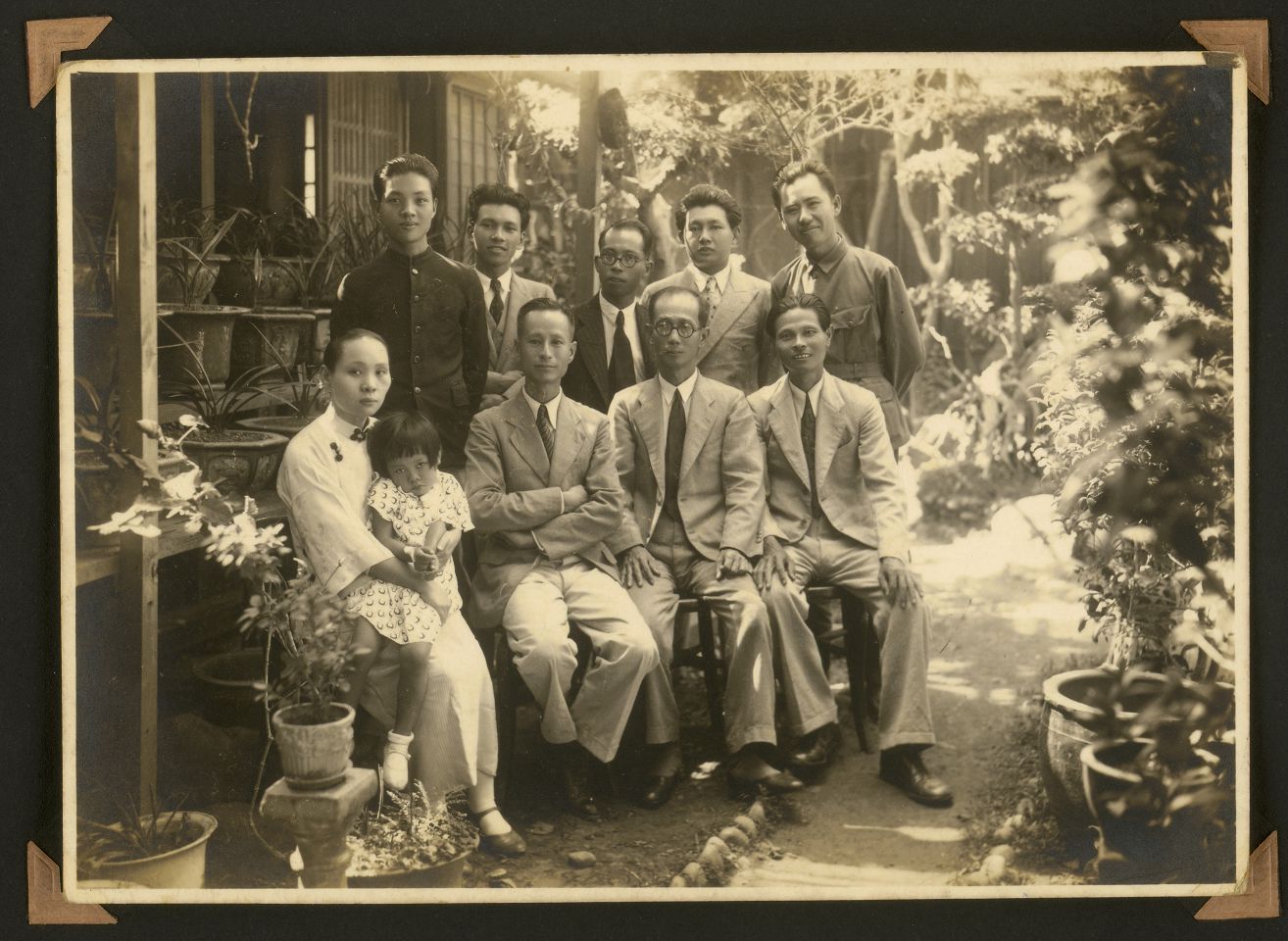
張李德和出身雲林西螺仕紳家庭,自幼研讀漢文,後入總督府國語學校附屬學校技藝科(今中山女中)接受新式教育。1912年嫁至嘉義後,她以詩社、雅集與文化活動深度參與地方藝文圈。1929年諸峰醫院洋樓落成,「琳瑯山閣」遂成為嘉義文人與畫家交流的重心;她因擅長書畫、熱情好客,成為凝聚地方藝術能量的關鍵人物。
《列女傳是如何寫成的》關注殖民現代性議題,以章節「潤厄年」聚焦乙未戰爭前後的動亂時期、「蔽芾年」描繪日本殖民統治穩定期,分別對應歷史進程中災難與蔭庇的雙重面向。在小說中,郭俞平將「宅邸」擬人化為重要的空間象徵,透過建築物「凸起」與「凹陷」,暗喻傳統文化在外來壓力下的變形與調適。小說裡的角色,同時也是歷史見證者「矮九」是李訓導的養子,生前「從未把自己想成『我』,他只用其他人看他的方式想自己」,典型道出底層主體於歷史敘事中的長期失語。而這種主體匱乏的存在狀態,反倒於關鍵時刻能穿透事物表象。當矮九被誤認為義勇軍而遭受槍決時,他感到「一道澄淨的光亮、一股強烈的情感流竄我的心中,就像我認定自己思所應思、為所應為時的感受,但卻又不一樣,那股高尚的思緒是我生前從未體驗過的。」死亡讓他超越肉身束縛,附身榕樹,以超自然視角展開故事——民間信仰中,榕樹被視為神靈棲所,其「年年發新枝,氣根如簾般垂落」的生長特性,使之成為連接天地、溝通生死的最佳媒介——長於宅邸與外界之間,是見證歷史最佳錨點,使矮九擁有「純粹的視覺,雙目高懸於樹冠之巔」,可穿透物質障礙洞察人心,不受制於線性時間。
以鬼魂為敘事主體的設定,巧妙解決了以歷史為原型的小說,如何在真實與虛構間找到適切敘事的倫理難題。矮九鬼魂「既不孤獨,亦未受認可」的曖昧存在,映照著深陷殖民歷史中不被正史承認的無數個體,小說的虛構特質使這些被排除在外的生命經驗得以重新納入敘事,補足官方歷史的匱缺。

另一個角色是生於觀音得道日的李訓導之女「小娘囡」(小李娘的暱稱),作者描述她「早慧,自小跟著父親讀四書五經。四歲時請了蒙師破蒙。」儘管受到父親疼愛,卻仍舊是時代的犧牲品。在「凹凸」一節中,藉由矮九魂魄對小李娘的觀察,作者則將「纏足」與「放足」置於殖民現代性的脈絡中審視。本節的主角小李娘對纏足懷有矛盾的認知,「她足夠理解纏足的疼痛。這是種良性的痛,就像經痛一樣。有某種東西將臻至完成,也就是說,某種內部過程即將完結,而不必要的東西將會被永遠移除。因此,痛會有,卻是必須要徹底奉行的功課。」,她深信「痛楚不會只有痛楚,還有其他東西,她將獲得補償和獎勵」。當主流審美推崇纏足,女性必然成為傷害自我的參與者;可是當放足成為新世代的文明標準時,拆纏足的場景又被描繪得充滿儀式性:當「帶著泛黃斑痕的長長布帛鬆散開來,因汗漬與藥粉而僵硬,盤旋脫落在地上,像蛇皮」,女體持續作為被觀看、規訓與定義的客體存在,小說精準描寫視覺權力機制的運作,「母親和幾位嬸母端坐在靠牆的太師椅上,神情各異」、「廚娘和院裡的孩子也都偷偷地湊近來,隔著窗隙摒息張望著」,這些目光在文字的鋪陳下構成了多重的監視網絡。當「女眷手端布料,步出院落,向老爺及會同之學校教師、醫師與日人官員呈報:小姐已解纏足」,女體轉化為一種公共展示與向殖民者的政治表態,李訓導藉由女兒的放足,選擇性地擁抱了殖民現代性,以此來維持其社會地位與文化權威,對李訓導而言,女兒的身體成為了一種政治協商的籌碼,然而,對小李娘自身來說,則必須重新調整早已內化的規訓機制,告訴自己「鬆開布帛的感覺真好」、「這是進步的,這樣做是對的」,所謂文明,只是一種改變了形式的束縛而已。
郭俞平著力於日本官員與地方士紳之間互動的微妙之處,如精通朱子學與漢詩的日本校長、從乙未戰爭初期的學塾停擺再到接納新式教育後穿上一件「合身的時髦新衣」的李訓導,雙方都在文化上彼此試探與適應。當典出《詩經》的「化民成俗」四個字出現在公學校的開校典禮——即殖民母國以嶄新詮釋建構其文化統治的合法性,地方士紳該如何見招拆招,展現本土文化的韌性,並於保持傳統文化內核的同時,吸收受新式教育理念及生活方式。
〈列女傳是如何寫成的〉呈現出殖民關係中的多重面向,既不將殖民者視為絕對的魔鬼,也沒有美化被殖民者的處境,而是反思進步背後需付出的代價,將殖民現代性的內在矛盾展露無遺——濁水治理工程雖可控制水患且增加肥沃新田,但往年清明時節,伴隨著河岸兩側的相關記憶也「一併從村子裡消失了」。
Kuo Yu-Ping’s How the Biographies of Exemplary Women Came to Be, which explores issues tied to colonial modernity, with two parts: “Year of Misfortune" and “Year of Thriving." The first focuses on tumult before and around the Yiwei War, while the latter illustrates the stability under Japanese colonization, both highlighting history’s dual nature as disaster and protection. In the story, Kuo personifies the “mansion" as a key symbol, with its architectural “protrusions" and “indentations" serving as metaphors for the distortion and adaptation of traditional culture under foreign pressure. The character “Ai-Jiu" (矮九), the adopted son of Li Hsun-Tao (李訓導), acts as a historical witness. Before his death, he “never saw himself as ‘I,’ but only through how others saw him," exemplifying the long-term silence of marginalized subjects in historical narratives. Such absence of subjectivity somehow allows a sharp clarity that goes beyond surface appearances at critical moments. When Ai-Jiu is mistaken for a volunteer soldier and executed, he feels “a pure light and strong emotion coursing through my heart, like recognizing my duty in thought and action, yet not the same—it was a noble feeling I never experienced when alive." Death frees him from the constraints of flesh; he then merges with a banyan tree, and the story unfolds from a supernatural perspective. In folk beliefs, the banyan tree is often seen as a divine dwelling, with “its yearly new branches and aerial roots hanging like curtains," serving as the perfect link between heaven and earth, as well as between life and death. This banyan tree, located between the mansion and the outside world, sits in the best spot to observe history, allowing Ai-Jiu to have “pure vision, with eyes hung high on top of the canopy," enabling him to see through material barriers and into human hearts, free from the limits of linear time.
Using the ghost as the narrator cleverly addresses the ethical issue in historically based fiction of balancing fact and fiction. Ai-Jiu’s ghost, “neither lonely nor recognized," is an ambiguous presence that represents countless unacknowledged individuals caught in colonial history. The story’s fictionality, however, allows overlooked and excluded life experiences to be reintroduced into the narrative, filling in the gaps in official history.
Another character is Li Hsun-Tao’s daughter, “Xiao Niang Jian" (小娘囡, nickname for Xiao Li Niang [小李娘], meaning “little young miss"), who was born on Guanyin Bodhisattva’s Enlightenment Day. She is described as “precocious, and has studied the Four Books and Five Classics with her father from a young age. By the age of four, she already had a private tutor." Despite her father’s love, she remains a victim of her time. In the “Indentations and Protrusions" chapter, the themes of foot-binding and unbinding are examined in the context of colonial modernity through the observations of Xiao Li Niang by Ai-Jiu’s ghost. Xiao Li Niang, the protagonist of this chapter, feels conflicted about foot-binding: “She fully understands the pain it causes, a benign pain, like menstrual cramps. It suggests a step closer to completion—that is, the completion of an internal process in which unnecessary parts are permanently removed. Thus, pain exists but is seen as a necessary lesson." She strongly believes that “pain was not merely pain. It involved something else, and she would be compensated and rewarded." While mainstream aesthetics endorse foot-binding, women inevitably engage in self-harm voluntarily. Conversely, when unbinding becomes a new standard of being civilized, the scene of unwrapping feet is ritualized: “Yellow-stained long clothes became loose, stiffened by sweat and medicinal powder, peeling away like snake skin on the ground." The female body remains an object being gazed upon, disciplined, and defined. The story effectively demonstrates the dynamics of visual power: “Mother and several aunts sat in chairs along the wall. Their expressions varied," and “the kitchen maids and children in the courtyard all secretly approached, holding their breath and peering through window cracks." The descriptions of their gaze establish multiple surveillance networks. When “the female relatives step out of the courtyard, carrying cloth in their hands, to report to the master, teachers, doctors, and Japanese officials, stating, ‘miss has unbound her feet,’ the female body becomes both a public display and a political statement to the colonizers. Li Hsun-Tao strategically embraces colonial modernity by having his daughter’s feet unbound to maintain his social status and cultural authority. To him, her daughter’s body serves as a bargaining chip in political negotiations. However, to Xiao Li Niang, the change implies adapting to an already internalized discipline, telling herself, “it feels good to loosen the cloth," and “this is progress, this is right." Civilization, in this context, is merely a new form of restraint.
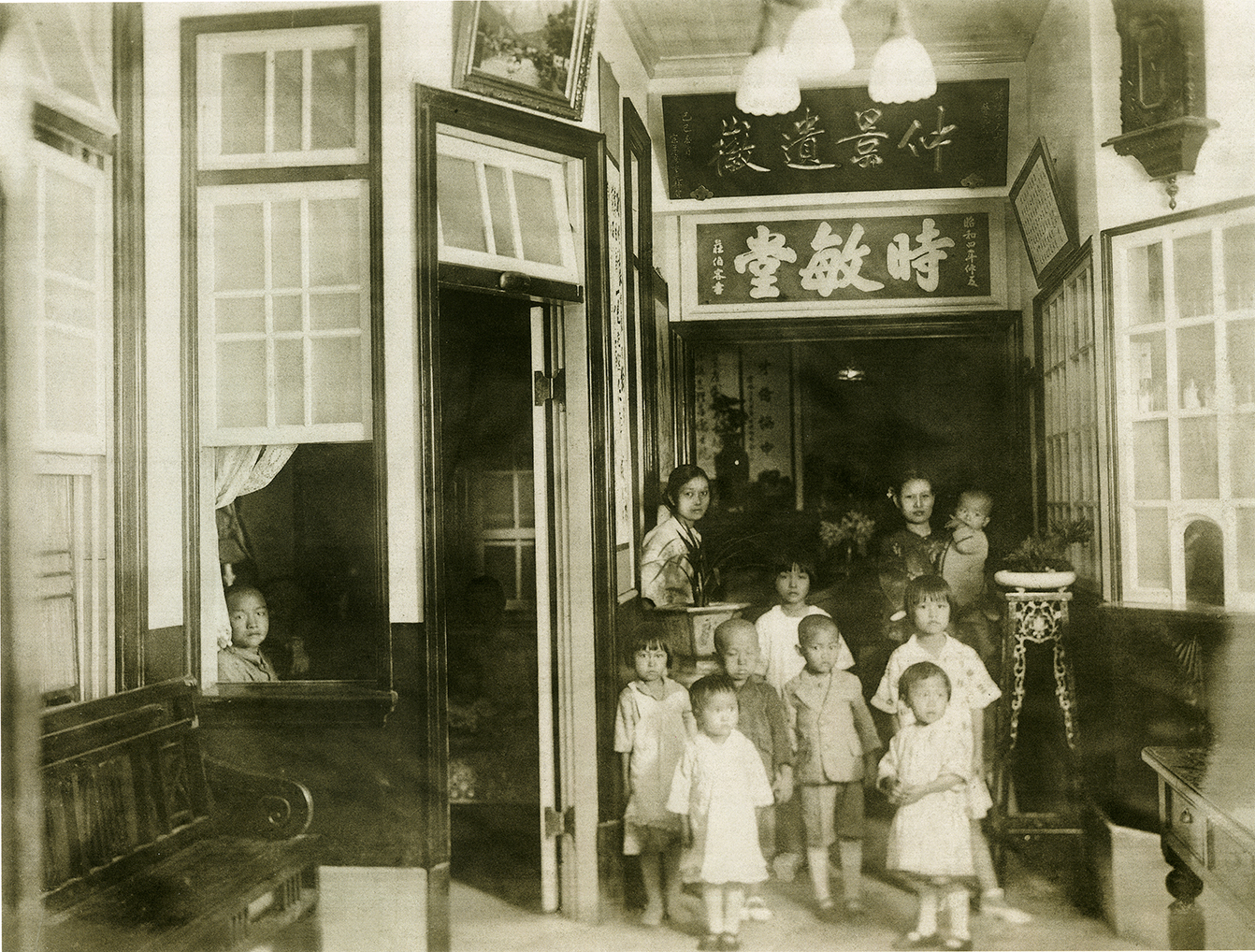
Meanwhile, Kuo also examined subtle interactions between Japanese officials and local gentry, such as a Japanese principal skilled in the teaching of Zhuzi (朱子, or Zhu Xi [朱熹]) and classical Chinese poetry, and Li Hsun-Tao, who moved from the school closure during the early Yiwei War period to accepting modern education, symbolized by putting on “a fitted, fashionable new garment."
Both sides culturally explore and adapt to each other. When the phrase “enculturating people to develop good customs" from The Book of Songs appears at the public school opening ceremony, it indicates the colonial power legitimizing its cultural rule through new interpretations. The local gentry’s tactful responses show the resilience of local culture, which preserves its core while adopting new educational ideas and ways of life.
How the Biographies of Exemplary Women Came to Be reveals the multiple facets of colonial relations, neither demonizing the colonizers nor romanticizing the circumstances of the colonized. Instead, it reflects on the costs of progress and fully exposes the internal contradictions within colonial modernity — while river regulation helps control floods and produces fertile, farmable land, nostalgic memories along the riverbanks “also vanish from the village" every year during Qingming.